Running Fine · No. 14
Turning the temperature down to dry the room
Relative humidity moves when temperature moves, even when nothing has been dried.
A space reads 60% RH, somebody drops the setpoint three degrees, and an hour later it reads higher. The call comes back in. Nothing failed; the room was cooled and no water left it.
Relative humidity is a ratio, not a quantity. It compares the water vapor in the air to the most that air could hold at its current temperature. Move the temperature and the ratio moves with it, whether or not a single grain of moisture went anywhere.
The problem
Take a room at 75F and 60% RH. The dewpoint is about 60F and the air carries roughly 0.0111 lb of water per lb of dry air. Cool it to 70F, remove no water, and it reads about 71%. Nothing dried; the same water is now a larger share of what colder air can hold.
Dewpoint is the number that tracks water. Two rooms both at a 55F dewpoint hold the same moisture, and if one sits at 70F and the other at 78F they will read roughly 59% and 45%. An operator comparing those two RH readings and concluding one room is wetter is comparing thermometers.
Water leaves air by condensing on something colder than its dewpoint: a cooling coil, a window, an uninsulated chilled water pipe. Lowering a zone setpoint does not make the coil colder. In most systems it makes the equipment run longer at the same coil condition, which helps while the coil is wet and does nothing once a compressor short cycles or a chilled water valve throttles back. In a VAV box the setpoint change reduces airflow, and less air across the same coil at the same supply temperature carries less water out of the building, not more.
Supply air temperature reset is the version of this that shows up in energy work. Raising SAT saves fan and chiller energy; it also warms the coil, and a coil whose apparatus dewpoint climbs above the space dewpoint stops dehumidifying while it is still cooling. Space temperature holds, the graphic looks fine, and the humidity walks up over the following few hours.
What we have seen
A research building on chilled beams where SAT had been raised to save energy. Colder supply air is protective in that building rather than wasteful: it dries the air and pulls the room dewpoint away from the beam surface temperature. The energy argument for raising it was sound in isolation and wrong for the building.
A building maximum-dewpoint calculation that discarded any reading above 65F and substituted zero. The intent was to reject a failed sensor. What it produced was a reported dewpoint of 0 on the one humid afternoon the number mattered, with every downstream interlock reading a bone-dry building. A rejected reading should hold last-good, not fall to zero.
A surgical suite where the specified leaving air dewpoint could not be reached at any coil selection, because leaving air dewpoint requires cooling the air to that temperature. Rows and fin spacing change capacity and approach; they do not let air leave a coil drier than the surface it touched.
And the ordinary one, several times a summer: a humidity complaint, a setpoint lowered three degrees, and an RH reading that went up.
What to do about it
- Put dewpoint on the graphic and trend it. Every BAS can calculate it from temperature and RH, and it is the only one of the three numbers that tells you whether the building is drying.
- Know which of three reasons your RH limit exists for, because they set different numbers. Condensation is a dewpoint-versus-surface-temperature question, and the limit comes from the coldest surface with margin, not from a round percentage. Mold and materials want an upper bound around 60% at the room’s own temperature. Comfort is where ASHRAE 55 puts its ceiling on a humidity ratio of 0.012 lb/lb, roughly a 62F dewpoint at sea level, and the point worth noticing is that the standard limits the water, not the ratio.
- Before raising SAT anywhere, check what the space dewpoint does at design latent load. A reset that is right in January can be wrong in July, which is an argument for scheduling the reset off dewpoint rather than off outdoor temperature.
- When the complaint is humidity, ask what the dewpoint was before and after the change. If nobody can answer, the sensor set is the first thing to fix.
Happy to walk through any of this.
References
Worth reading directly rather than taking our word for it.
- Building Science Corporation — the digest archive on moisture and dewpoint
- Caleffi idronics No. 13 and No. 28 — hydronic cooling and condensation
- ANSI/ASHRAE Standard 55 — the 0.012 lb/lb limit on the graphic comfort zone
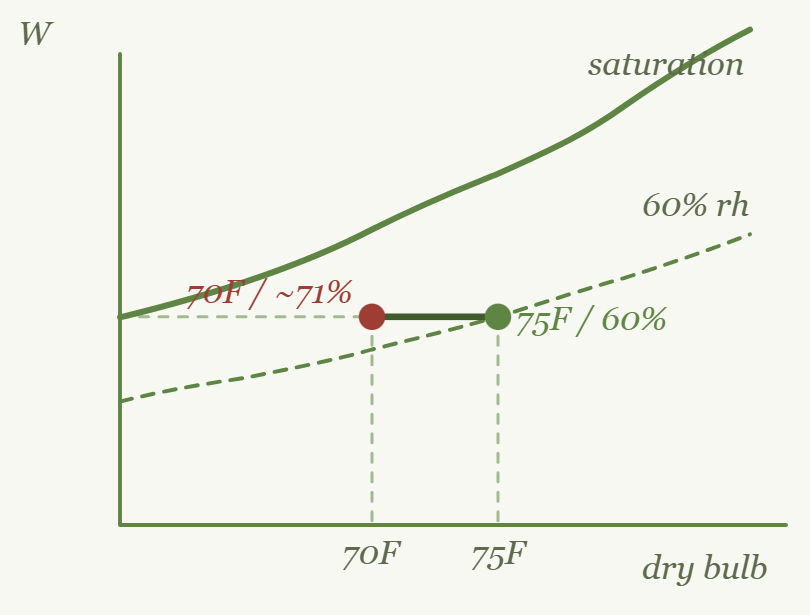
Same water, two temperatures. The horizontal run holds moisture constant; only the reading changed.
The coil has to get below the dewpoint of the air touching it. Nothing else dries anything.